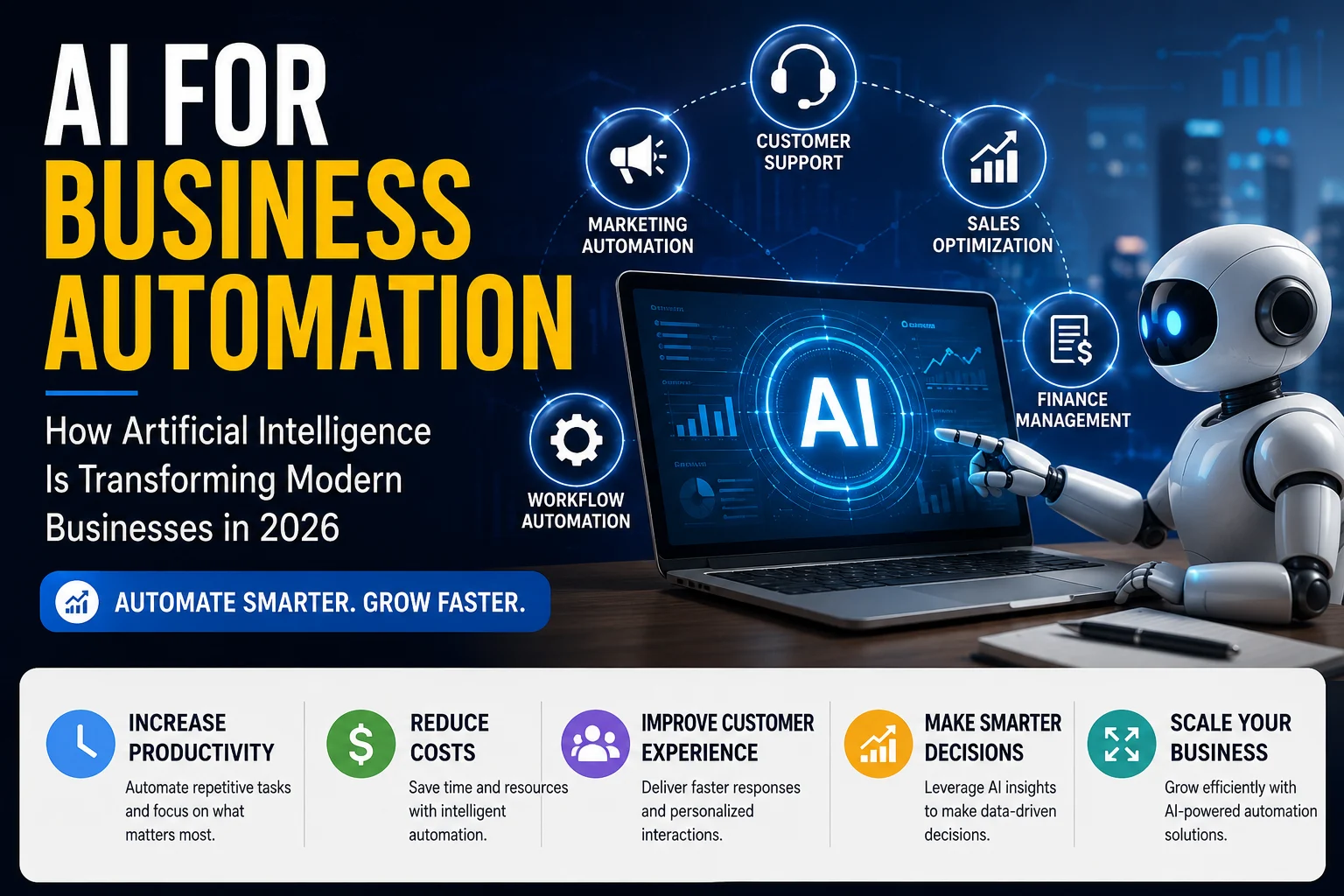
A Complete Guide to Growth, Productivity, and Automation
Artificial Intelligence (AI) is no longer limited to large corporations with massive technology budgets. In 2026, small businesses are increasingly adopting AI tools to improve efficiency, automate repetitive tasks, enhance customer experiences, and compete with larger organizations.
Whether you run an online store, a local service company, a digital agency, or a startup, AI-powered tools can help streamline operations while reducing costs. Many affordable AI solutions are now available through cloud-based platforms, making advanced technology accessible to businesses of all sizes.
This guide explores the best AI tools for small businesses, their benefits, practical applications, and how they can support sustainable business growth.
What Are AI Tools for Small Businesses?
AI tools are software applications that use artificial intelligence technologies such as machine learning, natural language processing, and predictive analytics to automate tasks and assist decision-making.
These tools can perform activities such as:
- Customer support automation
- Content creation
- Email marketing
- Data analysis
- Sales forecasting
- Appointment scheduling
- Inventory management
- Social media management
By automating routine work, business owners can focus on strategic growth and customer relationships.
Why Small Businesses Need AI in 2026
Small businesses often operate with limited staff and resources. AI helps bridge this gap by increasing productivity without significantly increasing operational costs.
Increased Efficiency
AI can automate repetitive administrative tasks, allowing employees to focus on higher-value activities.
Cost Savings
Businesses can reduce manual labor requirements while maintaining operational quality.
Better Customer Service
AI-powered systems provide faster responses and support availability around the clock.
Data-Driven Decisions
Business owners can use AI analytics to understand customer behavior and market trends.
Competitive Advantage
Companies that embrace AI technology often respond more quickly to changing market conditions.
Best AI Tools for Small Businesses
AI Writing and Content Creation Tools
Content marketing remains one of the most effective ways to attract customers online.
AI writing tools can assist with:
- Blog article creation
- Product descriptions
- Marketing copy
- Email campaigns
- Social media content
These tools help businesses publish content more consistently while saving time.
For example, businesses can create educational content and link relevant learning resources from exammcqs.com when discussing technology, education, or professional development topics.
AI Customer Support Tools
Customer service plays a critical role in business success.
AI-powered customer support systems can:
- Answer frequently asked questions
- Resolve common issues
- Schedule appointments
- Route inquiries to the correct department
- Provide support 24/7
This improves customer satisfaction while reducing support costs.
AI Marketing Automation Platforms
Marketing automation has become one of the most valuable applications of AI.
These platforms can:
- Segment customer audiences
- Personalize marketing messages
- Optimize email campaigns
- Recommend advertising strategies
- Analyze campaign performance
Businesses can improve conversion rates while reducing manual effort.
AI Sales Tools
Sales teams can use AI to identify opportunities and prioritize leads.
Common features include:
- Lead scoring
- Customer relationship analysis
- Revenue forecasting
- Automated follow-ups
- Pipeline management
These capabilities help businesses generate more revenue while improving sales efficiency.
AI Social Media Management Tools
Managing multiple social media accounts can be time-consuming.
AI-powered social media tools assist with:
- Content scheduling
- Post recommendations
- Audience analytics
- Trend monitoring
- Engagement optimization
Businesses can maintain a strong online presence with less manual effort.
AI Accounting and Finance Tools
Financial management is essential for long-term business success.
AI accounting solutions can automate:
- Invoice processing
- Expense tracking
- Financial reporting
- Tax preparation assistance
- Cash flow forecasting
Automation reduces errors and provides greater financial visibility.
AI Tools for Human Resources
Small businesses often have limited HR resources.
AI-powered HR platforms help with:
- Resume screening
- Candidate matching
- Interview scheduling
- Employee onboarding
- Performance analytics
These tools simplify recruitment and workforce management.
AI-Powered Data Analytics
Every business generates valuable data, but many struggle to use it effectively.
AI analytics tools help organizations:
- Identify customer trends
- Predict future sales
- Analyze marketing performance
- Optimize inventory levels
- Improve operational efficiency
Data-driven insights can significantly improve decision-making.
Benefits of AI Adoption for Small Businesses
Faster Operations
AI completes tasks much faster than manual processes.
Improved Accuracy
Automation reduces human errors in data processing and reporting.
Enhanced Customer Experience
Customers receive quicker responses and more personalized interactions.
Better Resource Allocation
Employees can focus on activities that require creativity and strategic thinking.
Scalable Growth
Businesses can handle increasing workloads without proportionally increasing staffing costs.
Challenges Small Businesses Should Consider
While AI offers many advantages, successful implementation requires planning.
Learning Curve
Teams may need training to use AI tools effectively.
Data Privacy
Businesses must ensure customer information remains secure.
Integration Requirements
Some tools may require integration with existing software systems.
Ongoing Costs
Subscription fees should be evaluated against expected returns.
Careful planning can help maximize the value of AI investments.
How to Choose the Right AI Tool
Not every AI solution is suitable for every business.
When evaluating AI tools, consider:
Business Goals
Identify the specific problems you want to solve.
Ease of Use
Choose platforms that employees can learn quickly.
Scalability
Select solutions that can grow alongside your business.
Security Features
Ensure the provider follows strong data protection practices.
Customer Support
Reliable support is important when implementing new technologies.
Future Trends in AI for Small Businesses
The role of AI in small business operations will continue expanding.
Emerging developments include:
- Hyper-personalized customer experiences
- Autonomous business workflows
- Advanced predictive analytics
- AI-powered virtual assistants
- Intelligent business intelligence systems
Businesses that adopt AI strategically today will be better positioned for future growth.
Final Thoughts
AI tools are transforming how small businesses operate in 2026. From marketing and customer service to accounting and analytics, artificial intelligence helps organizations improve productivity, reduce costs, and make smarter decisions.
The most successful businesses view AI as a tool that enhances human capabilities rather than replacing them. By combining technology with human expertise, small businesses can create better customer experiences and achieve sustainable growth in an increasingly competitive marketplace.
As AI technology continues to evolve, staying informed about emerging tools and best practices will become an essential part of modern business success. Small businesses that embrace innovation today will be better prepared for the opportunities of tomorrow.