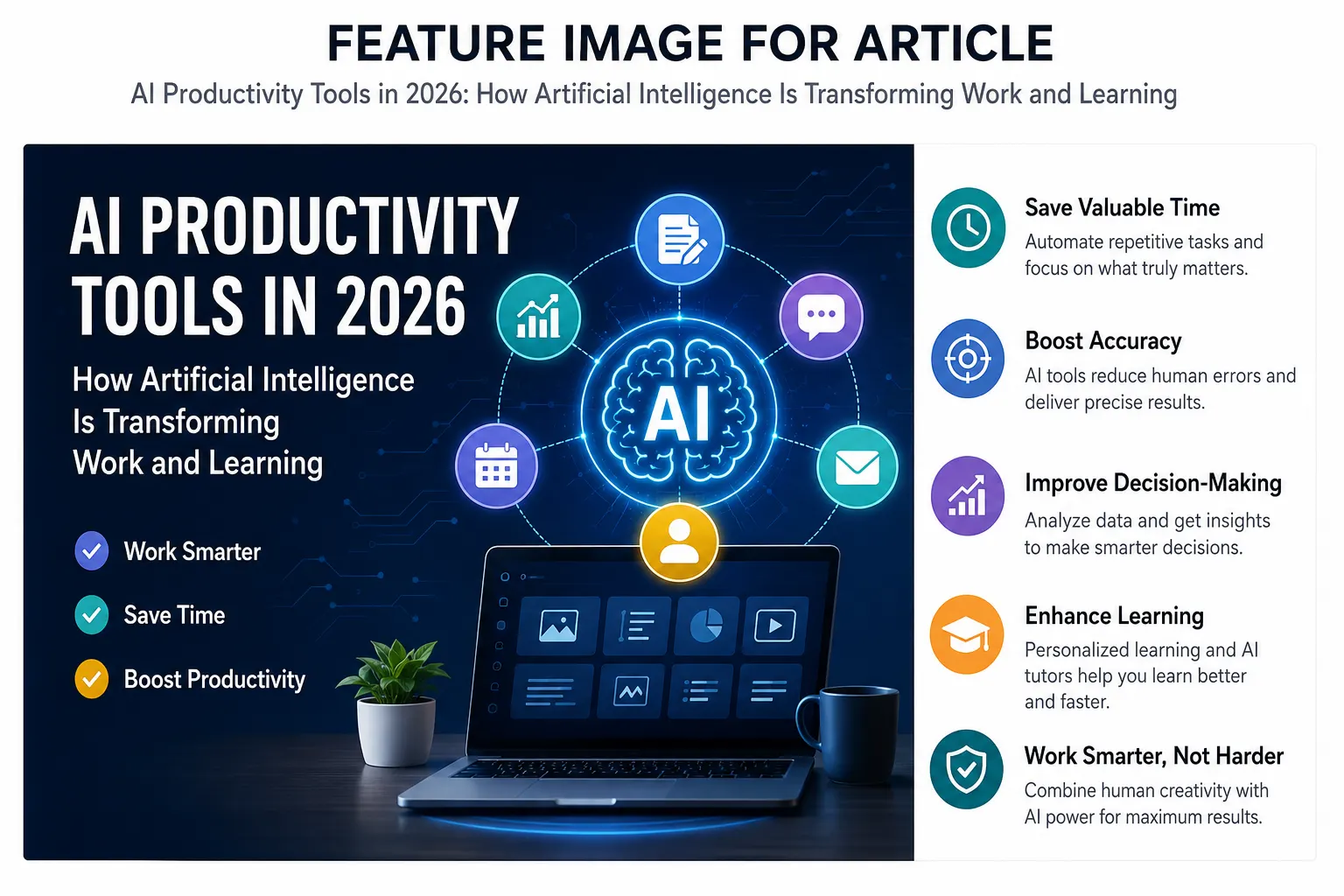
Artificial Intelligence (AI) is no longer a futuristic concept reserved for technology companies. In 2026, AI has become an essential part of daily life, helping students, professionals, businesses, and content creators improve productivity and save valuable time. From writing assistance and data analysis to customer support and personalized learning, AI-powered tools are changing how people work, study, and solve problems.
As AI technology continues to evolve, understanding its practical applications has become increasingly important. Whether you are a student preparing for competitive exams or a business owner looking to improve efficiency, AI tools can provide significant advantages when used responsibly.
What Are AI Productivity Tools? AI Productivity Tools in 2026
AI productivity tools are software applications that use machine learning, natural language processing, and automation technologies to perform tasks that traditionally required human effort. These tools analyze information, recognize patterns, and generate useful outputs to help users complete tasks more efficiently.
Some common examples include:
- AI writing assistants
- Automated scheduling tools
- AI-powered search engines
- Virtual meeting assistants
- Data analysis platforms
- Learning and tutoring applications
- Customer service chatbots
The primary goal of these tools is not to replace human intelligence but to enhance it by automating repetitive tasks and providing intelligent assistance.
Why AI Productivity Tools Are Becoming Essential
The modern workplace demands speed, accuracy, and adaptability. Professionals are expected to manage large amounts of information while maintaining high-quality results. AI helps meet these expectations by reducing manual workload.
Key benefits include:
Time Savings
AI can automate repetitive activities such as email drafting, scheduling meetings, summarizing documents, and organizing information. This allows users to focus on higher-value work.
Improved Accuracy
Many AI tools can identify errors, suggest improvements, and analyze large datasets with greater consistency than manual processes.
Better Decision-Making
AI-powered analytics platforms help users uncover trends and insights that may otherwise go unnoticed.
Enhanced Learning
Students can use AI tutoring systems to receive personalized explanations, practice questions, and study recommendations tailored to their learning style.
For students preparing for competitive exams, educational resources available on exammcqs.com can be combined with AI-assisted study methods to create a more efficient learning experience.
Popular Categories of AI Tools AI Productivity Tools in 2026
AI Writing Assistants
Writing assistants help users generate content ideas, improve grammar, enhance readability, and optimize content for search engines.
These tools are commonly used by:
- Bloggers
- Students
- Researchers
- Marketing professionals
- Business owners
While AI can accelerate content creation, human editing remains essential to ensure accuracy, originality, and authenticity.
AI Research Tools
Research platforms can summarize lengthy articles, extract important information, and organize findings efficiently.
Benefits include:
- Faster information gathering
- Improved note-taking
- Better content organization
- Enhanced knowledge retention
AI Learning Platforms
Educational AI systems provide personalized study recommendations based on individual performance.
Features often include:
- Adaptive learning paths
- Practice assessments
- Instant feedback
- Progress tracking
Students preparing for examinations can benefit significantly from combining AI learning systems with structured MCQ practice available through educational websites such as exammcqs.com.
AI Business Automation Tools
Businesses use AI to automate routine operations, including:
- Customer support
- Appointment scheduling
- Inventory management
- Data entry
- Report generation
These applications help organizations reduce operational costs while improving customer experiences.
How AI Is Changing Education AI Productivity Tools in 2026
Education is one of the industries experiencing the most significant AI-driven transformation.
Teachers and students now have access to intelligent systems capable of:
- Creating personalized learning plans
- Identifying knowledge gaps
- Generating quizzes and assessments
- Providing instant explanations
- Supporting multilingual learning
AI does not replace educators. Instead, it acts as a supportive tool that enables more efficient and personalized instruction.
For exam preparation, students can combine AI-generated practice materials with verified educational resources to strengthen their understanding of key concepts.
Best Practices for Using AI Responsibly
Although AI offers many benefits, responsible use remains critical.
Verify Information
AI-generated content can occasionally contain inaccuracies. Always cross-check important facts using reliable sources.
Protect Privacy
Avoid sharing sensitive personal, financial, or confidential information with AI systems unless you fully understand the platform’s privacy policies.
Use AI as a Tool
The most successful users treat AI as an assistant rather than a replacement for critical thinking.
Maintain Human Oversight
Human review ensures that content remains accurate, ethical, and aligned with specific goals.
Future Trends in Artificial Intelligence
Several emerging trends are expected to shape the future of AI.
Personalized AI Assistants
Future AI systems will better understand individual preferences and workflows, providing increasingly customized support.
Advanced Multimodal Systems
AI models will continue improving their ability to process text, images, audio, and video simultaneously.
Smarter Business Automation
Organizations will adopt more sophisticated AI solutions capable of handling complex workflows with minimal supervision.
AI-Powered Education
Personalized tutoring systems will become more accessible, helping learners receive targeted support based on their unique needs.
Challenges Facing AI Adoption
Despite its advantages, AI adoption presents several challenges.
These include:
- Data privacy concerns
- Ethical considerations
- Algorithmic bias
- Regulatory compliance
- Workforce adaptation
Addressing these issues requires collaboration among technology companies, governments, educators, and users.
Final Thoughts
Artificial Intelligence is transforming how people learn, work, and interact with technology. From education and business automation to content creation and research, AI productivity tools offer opportunities to improve efficiency and achieve better outcomes.
However, successful AI adoption depends on responsible usage, critical thinking, and continuous learning. By understanding both the strengths and limitations of AI, individuals and organizations can make informed decisions that maximize benefits while minimizing risks.
As AI technology continues to evolve, staying informed about emerging tools and best practices will become increasingly important. Those who learn to work alongside AI effectively will be better positioned to succeed in the digital economy of the future.
Whether you are a student preparing for exams, a professional seeking greater productivity, or a business owner exploring automation, AI can serve as a valuable partner in achieving your goals.